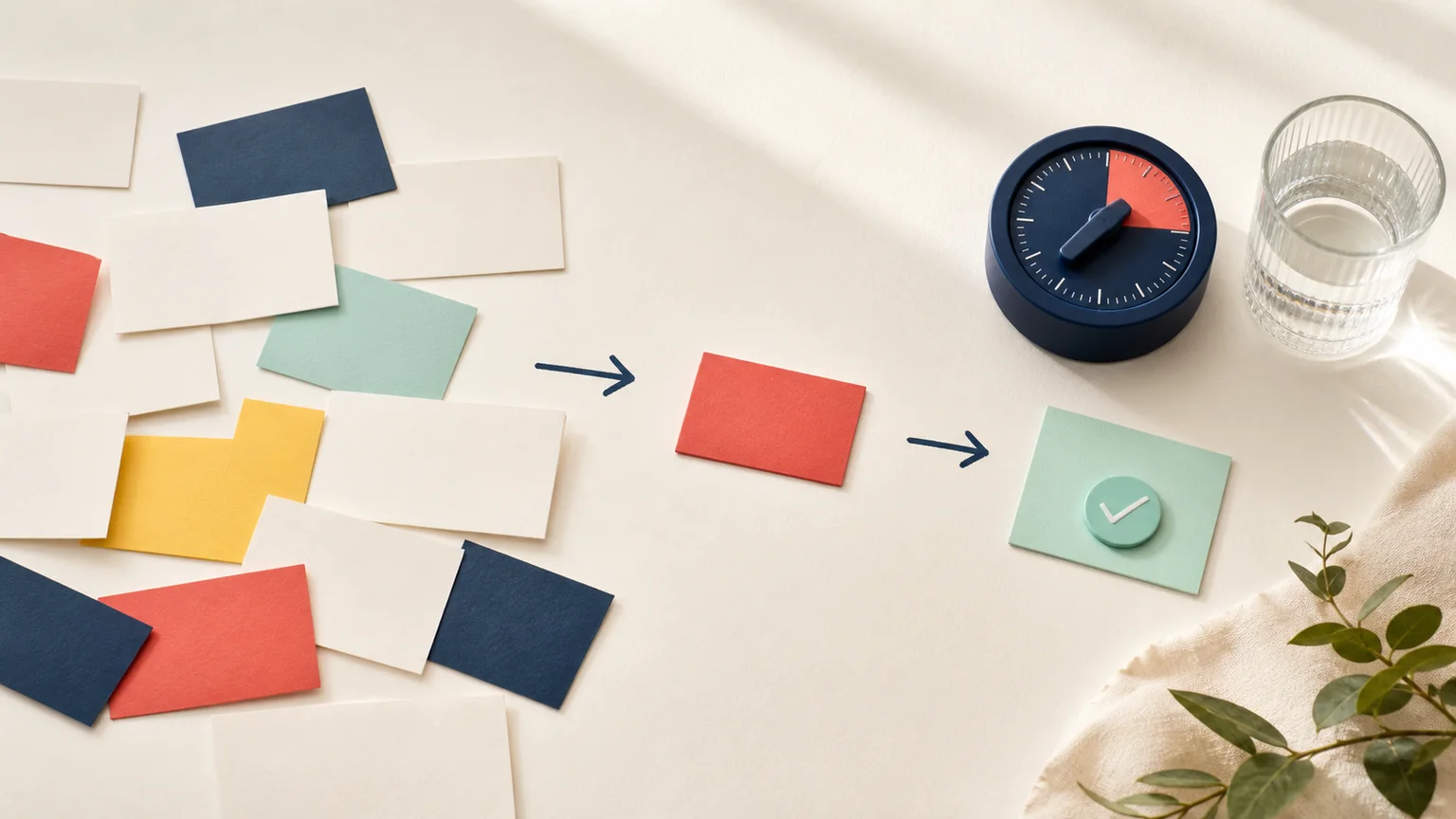
When you feel overwhelmed and cannot focus, reduce the number of decisions before demanding more concentration. This ten-minute reset helps you pause, move open loops out of your head, separate “now” from “later,” choose one visible action, and begin for just a few minutes.
The reset will not solve an unsafe workload, a crisis, or a health condition. It is a practical way to regain enough orientation for the next decision.
Why focusing can feel impossible when everything is open
Overwhelm often combines too much input with too little certainty. Several tasks feel urgent, the finish lines are unclear, and every choice seems to carry a consequence. The brain keeps scanning the full field instead of settling on one action.
Telling yourself to “focus harder” does not close those loops. A more useful first move is orientation: identify what is real, what is only being held in memory, what can wait, and what action would reduce the most immediate pressure.
- If there is an immediate safety, health, or legal emergency, contact the appropriate local service or trusted professional.
- If you are physically unwell, address basic needs and medical concerns first.
- If another person controls the deadline or information, the next action may be communication—not more private effort.
The 10-minute overwhelm reset
Minute 0–1: Pause and orient
Put both feet on the floor if that is comfortable. Look around and name three neutral things you can see. Take one slower breath without forcing a particular pattern. Say what is happening in plain language: “I have several open decisions and I cannot see the next one.”
The World Health Organization’s stress-management resources include grounding and “notice and name” practices as ways to reconnect with the present moment during stress. Use them as brief orientation tools, not as a demand to make difficult feelings disappear.
Minute 1–3: Unload every open loop
On paper or in one note, write short fragments for everything asking for attention. Do not organize yet. Include work, home, messages, worries, and missing information. The list can be messy because its purpose is to stop memory from refreshing each item repeatedly.
Use nouns and verbs: “invoice,” “reply to Maya,” “school form,” “ask for deadline,” “eat lunch.” Avoid turning each entry into a full project plan.
Minute 3–5: Mark now, later, or not mine
Place one symbol beside each item:
- Now: has a real consequence today or unlocks another urgent action.
- Later: matters, but no useful action is required in this ten-minute window.
- Not mine: requires information, permission, delegation, or someone else’s decision.
Limit “Now” to one or two items. If everything remains “Now,” write the specific consequence and time beside each. Urgency becomes easier to compare when it is concrete.
Minute 5–7: Choose the smallest useful next action
Pick the action that reduces immediate pressure or creates new information. “Fix project” becomes “email Sam for the missing number.” “Deal with bills” becomes “open the electricity bill and check the due date.” “Catch up on everything” becomes “tell the client when I can send an update.”
The action should be observable and should not contain “and.” If it still feels heavy, use the task-paralysis guide to shrink it again.
Minute 7–10: Begin, communicate, or schedule
Work on the action for three minutes. If action is blocked, send the message that names the dependency. If the item truly belongs later, put it in a trusted place with a specific review time.
At minute ten, choose deliberately. Continue if momentum is useful. Otherwise stop and leave a return note. The reset succeeds when you have a clearer next decision—not only when the whole problem disappears.
Three worked examples
| Overwhelming thought | What the reset reveals | First useful action |
|---|---|---|
| “I am behind on the entire project.” | The draft is blocked by one missing approval. | Send the approver two options and a response deadline. |
| “The whole house is a mess.” | The kitchen surface is preventing dinner preparation. | Move every item that does not belong on the counter into one temporary basket. |
| “I have too many messages.” | Only one message has a consequence today. | Reply to that message with the decision or a realistic update time. |
Example: an overloaded workday
Your list contains a proposal, invoices, email, a team question, and a late report. After writing consequences, you notice the team question blocks two other people. The first action becomes “send the missing file link.” The report becomes “email a realistic delivery update.” The proposal gets a thirty-minute window after lunch. The plan is not complete, but the next two pressure points are visible.
Example: a low-energy home evening
You planned laundry, exercise, meal preparation, and paperwork. The reset shows that food and tomorrow’s medication pickup are the real constraints. The minimum plan becomes “prepare the easiest available meal” and “set the pickup reminder.” Laundry moves to tomorrow. Rest is now a deliberate part of the plan rather than evidence that the whole evening failed.
What not to do during the reset
- Do not rebuild your entire productivity system. You need one useful decision, not a new app.
- Do not research every option. Ask what information is necessary for the next reversible step.
- Do not copy the full backlog into today. Keep “later” in a trusted parking list.
- Do not hide communication problems inside task lists. A deadline conflict often needs an honest message.
- Do not treat calm as a prerequisite. You can take a small action while still feeling unsettled.
Build a lighter system after the immediate pressure drops
Use one daily priority
A short daily focus planner reduces repeated prioritization. Choose one meaningful priority, maintenance tasks, and a minimum version before the busiest part of the day.
Create a waiting-for list
Record tasks blocked by another person, along with the next follow-up date. This keeps dependencies from returning to the daily list as if more effort from you could finish them.
Leave transition buffers
Travel, setup, switching, decompression, and unexpected conversations consume time. Add them to the plan. A calendar filled edge to edge turns every small delay into a crisis.
Review capacity, not just tasks
Notice when sleep, illness, caregiving, grief, workload, or repeated interruption changes what is realistic. Reduce or renegotiate commitments where possible instead of demanding the same plan from different circumstances.
When overwhelm needs more than a productivity reset
The World Health Organization’s stress guidance recommends practical stress-management skills, routines, sleep, connection, and seeking support when coping is difficult. Its Doing What Matters in Times of Stress guide includes brief grounding and awareness exercises.
Seek appropriate professional help if overwhelm is persistent, worsening, or interfering with sleep, eating, work, relationships, self-care, or safety. If you might harm yourself or someone else, or you are in immediate danger, contact local emergency services or a crisis service in your country. A ten-minute planning exercise is not emergency or mental-health treatment.
Focusing when overwhelmed: common questions
What if I cannot choose the most important task?
Compare the nearest real consequence, the task that unlocks other work, and the action that creates missing information. If two items remain urgent, give each a small finish line.
Should I calm down before I start?
No. Orientation can help, but complete calm is not required. Choose a small, safe action you can take while the difficult feeling is still present.
What if ten minutes is too much?
Use three minutes: one minute to unload, one to mark now/later, and one to begin the smallest useful action or send the needed message.
Is overwhelm a sign of ADHD or anxiety?
Not by itself. Many circumstances and health conditions can contribute. A qualified professional can assess persistent or impairing symptoms.
Your kind next step
Set a ten-minute timer. Write every open loop, mark each one now, later, or not mine, and begin one visible action for three minutes. If you want help identifying whether decision fog, start friction, distraction, or energy mismatch is strongest today, take the private Focus Map quiz.