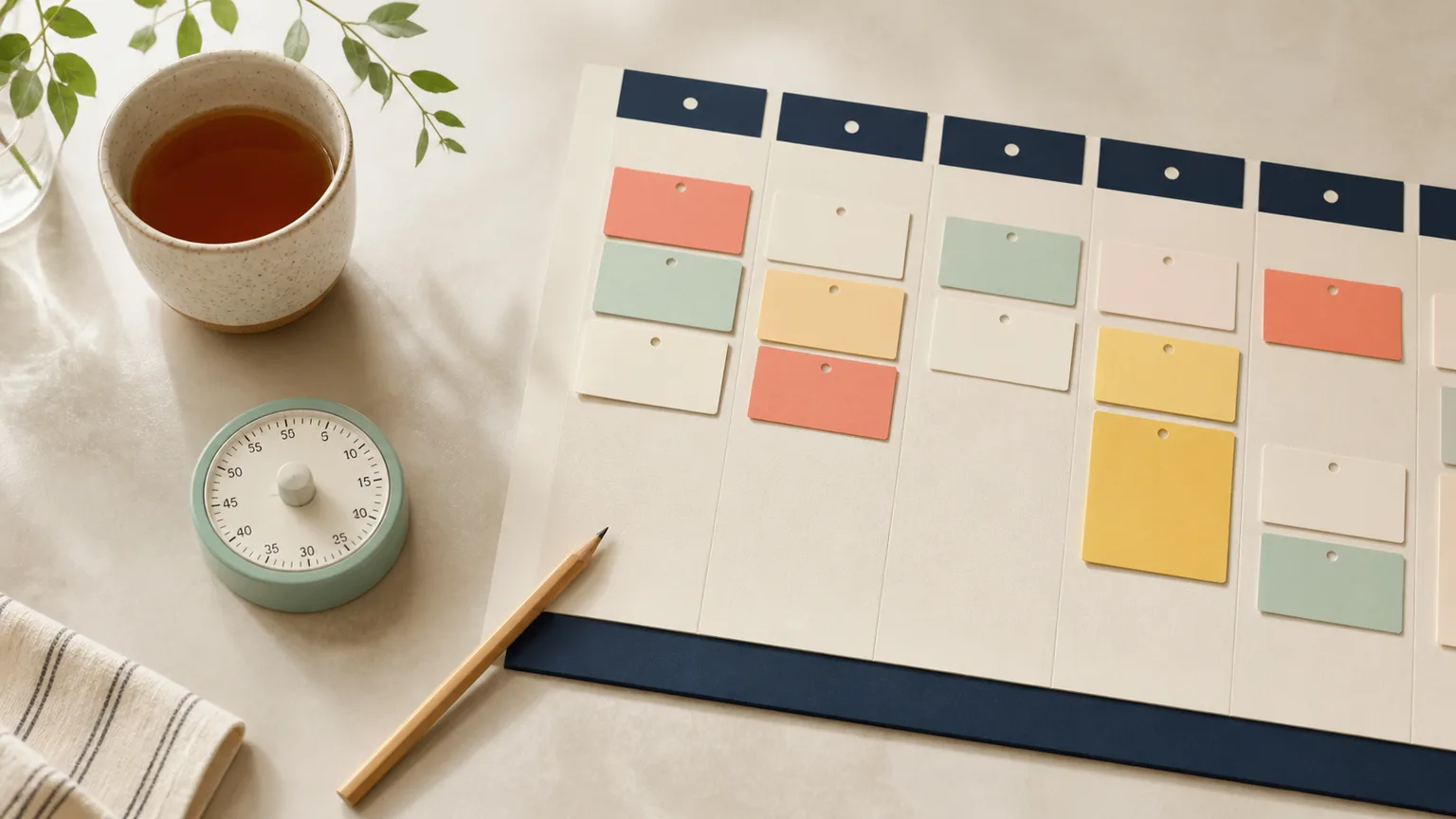
To plan tomorrow in five minutes, check fixed commitments, choose one meaningful priority, select one maintenance task, prepare the first physical action, and define a minimum version.
Evening planning should reduce tomorrow’s starting cost, not become a second workday. Five minutes is enough to make the first decision visible while leaving room for information and energy that will only be known tomorrow.
The purpose of a tomorrow plan
A useful evening plan creates orientation. It does not predict every interruption or fill every hour. The highest-value choice is often the first action: opening the correct file, placing materials by the door, or writing the question the next session must answer.
Planning can become avoidance when it expands into reorganizing the whole backlog. A short boundary keeps preparation connected to action.
- You spend longer planning than doing the first task.
- You fill tomorrow without checking appointments or travel.
- You choose several priorities because one feels uncomfortable.
- The morning still begins with searching for files or deciding where to start.
The five-minute tomorrow plan
Use one minute per step. Stop when tomorrow’s entry point is clear.
1. Minute one: check constraints
Look at appointments, travel, caregiving, deadlines, and the time actually available. Do not treat every open calendar space as productive capacity.
2. Minute two: choose one priority
Define one visible result that matters tomorrow. Prefer “send the revised outline” over a broad category such as “project work.”
3. Minute three: protect maintenance
Choose one small task that prevents noise from growing: pay a bill, confirm an appointment, or answer a blocking message.
4. Minute four: prepare the first action
Open the document, place the object in sight, or write a return note. Make beginning possible before motivation must negotiate with setup.
5. Minute five: define the minimum
Write the smaller version you may use if sleep, health, or circumstances change. The minimum is an adaptation rule, not a hidden promise to finish.
Five-minute plans for different tomorrow shapes
| Situation | Unhelpful default | Kinder experiment |
|---|---|---|
| Meeting-heavy day | Add creative work to every gap | Priority: send agenda before first call; maintenance: invoice one client |
| Study day | Plan to finish every chapter | Priority: outline one essay section; prepare the question and source notes |
| Home day | List every unfinished chore | Priority: book the repair; maintenance: clear one food-prep surface |
| Uncertain energy | Wait until morning to decide everything | Prepare one standard action and one two-minute minimum version |
Turn the method into a seven-day experiment
Do not rebuild your entire routine around one article. Choose one recurring situation where plan tomorrow is relevant, and test the method for seven days or three real attempts. Keep the scope stable enough to learn from it.
- Record the starting condition. Note the time, available energy, environment, and the specific result you need.
- Begin with “Minute one: check constraints.” Use the smallest version that still touches the real situation.
- Practice “Minute three: protect maintenance.” Change only one important condition rather than optimizing everything at once.
- Close with “Minute five: define the minimum.” Leave evidence that makes the next attempt easier.
Measure friction, not personal worth
Use a tiny log with four fields: time to begin, number of unplanned switches, whether a visible result was produced, and how easy the task was to return to. A one-to-five “starting friction” rating can be useful when it describes the situation rather than your character.
At the end of the experiment, keep the part that reliably reduced friction, adapt the part that did not fit, and remove anything that created extra maintenance. One good outcome is a clearer explanation of what blocks the task—even when output does not immediately increase.
Adapt it to your environment
Planning experiments work best when the plan stays smaller than the work. Keep one trusted backlog, show only current commitments, and review at a predictable time. If maintaining the system takes more attention than it saves, remove a layer before adding a new tool.
What commonly goes wrong
- Planning every minute: preserve buffers and let tomorrow provide new information.
- Choosing a topic instead of an outcome: write what will be visible or sent.
- Preparing only mentally: move a file, object, or note into the path of action.
A lower-capacity version
Check the calendar, write one essential outcome, and place the first needed object or file in sight. Skip the rest of the routine and let that prepared entry point be enough.
Evidence, limits, and when to seek support
This guide offers educational planning ideas, not mental-health treatment. The World Health Organization’s stress guidance emphasizes practical coping skills, routine, sleep, connection, and appropriate professional support. If stress, exhaustion, avoidance, or concentration problems are persistent, worsening, or significantly disrupting daily life, consider speaking with a qualified healthcare professional.
For a broader system, use our daily focus planner. If beginning is the main obstacle, try the task-paralysis reset. To protect attention after starting, read how to stop being distracted.
Planning tomorrow: common questions
Is it better to plan at night or in the morning?
Use the time you can repeat. Evening preparation lowers morning decisions; a brief morning review lets you adjust to current energy and new information.
What if tomorrow changes completely?
Keep fixed commitments, reassess the priority, and use the minimum version. A flexible plan includes permission to change.
Should I plan weekends too?
Only if a light plan reduces stress. Rest, relationships, and unstructured time can be intentional parts of the plan.
How detailed should the first action be?
Detailed enough that your hands can move without another planning session: open, place, copy, call, or write one visible item.
Your kind next step
Set a five-minute timer tonight and stop as soon as one priority, one maintenance task, and one prepared first action are visible. If you want help naming today’s strongest friction, take the private Focus Map quiz.