If you want to stop being distracted, begin by making your intended task easier to return to. Attention naturally shifts. A practical system reduces unnecessary pulls, gives wandering thoughts somewhere safe to go, and leaves a visible path back after an interruption.
You do not need perfect discipline or a silent room. You need to identify the kind of distraction you are facing and change one source of friction at a time.
First identify the kind of distraction
External distraction
Notifications, conversations, noise, visible clutter, and an open phone are external pulls. The most effective response is often environmental: mute, move, close, schedule, or create a boundary.
Internal distraction
Remembered errands, worry, boredom, hunger, and new ideas arise inside the work period. Trying not to think about them can consume more attention. A trusted capture note and planned check-in give the thought somewhere to go.
Task-based distraction
Sometimes the task itself keeps pushing attention away because it is vague, oversized, repetitive, or emotionally loaded. In that case, another blocking app will not solve the real problem. Clarify the first observable action or use the task-paralysis reset.
9 gentle ways to protect your attention
1. Write a return sentence
Before starting, finish this sentence: “When I come back, the next action is…” Make it concrete: “compare the two prices in row four,” not “continue research.” This creates a bookmark for your attention.
2. Move the phone, not your personality
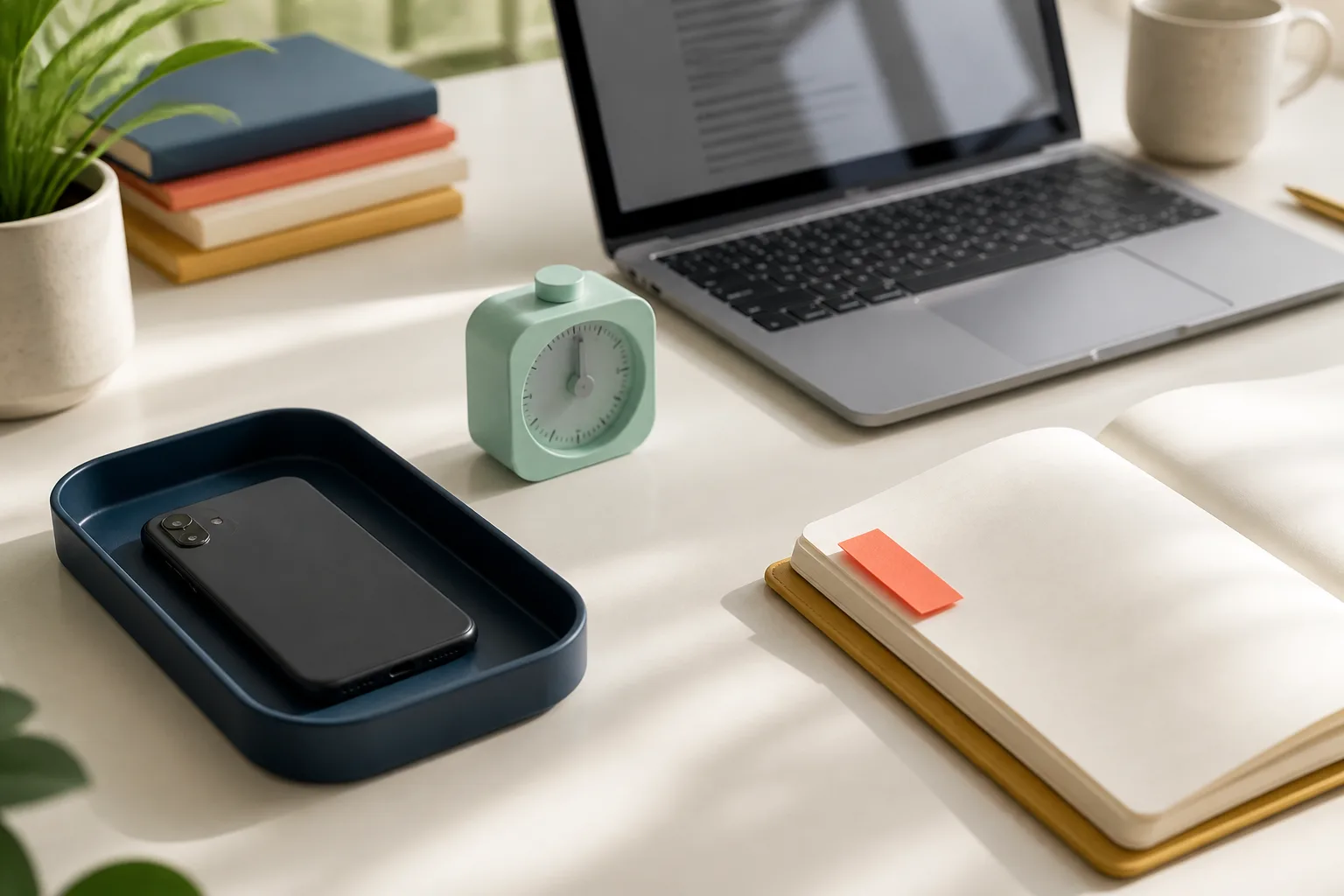
Put it outside arm’s reach, face down in a tray, or behind the laptop. Keep calls from important people available if needed, but remove the easy visual cue. A small physical distance inserts a moment in which you can choose rather than react automatically.
3. Use one “not now” capture place
Keep a sheet of paper or one digital note for thoughts that do not belong to the current work period. Write only enough to trust that the thought will not disappear. Review the list at a scheduled time instead of solving each item immediately.
4. Close visual loops
Leave visible only the files, objects, and tabs needed for the next action. Save useful tabs to a named group or reading list. A clear screen does not create focus by itself, but it removes repeated invitations to switch.
5. Shorten the focus promise
Commit to ten or twenty minutes of returning, not an afternoon of flawless concentration. A small period makes the cost predictable. When the timer ends, pause, continue, or take a real break.
6. Group communication windows
If your work permits it, choose specific times for email and messages. Tell collaborators when you will respond and keep a route for genuine urgency. Boundaries work better when other people understand them.
7. Make progress visible
A three-step checklist gives attention a specific landing place. “Research competitor, choose example, draft opening” is easier to resume than “work on article.” Cross off the actual step, not the entire project.
8. Match stimulation deliberately
Some people work better with neutral sound, a standing interval, a fidget object, or quiet co-working. Others need less stimulation. Test one change for several sessions and notice the result instead of stacking five new techniques at once.
9. Use a reset instead of a verdict
When you notice you have drifted, avoid turning the moment into a judgment about your character. Close the unrelated loop, record anything worth keeping, read the return sentence, and resume for one small interval.
- Write one outcome for this period.
- Write the next physical action.
- Move the phone and mute optional alerts.
- Open one capture note.
- Set a realistic stop time.
A 90-second ritual after an interruption
- Stop the new loop. Save, close, or write down what pulled you away.
- Orient yourself. Read the last line you wrote or look at the last completed checklist item.
- Restate the next action. Make it smaller if it is no longer obvious.
- Restart for five minutes. You are rebuilding context, not proving you can focus forever.
If interruptions are frequent, leave a return note before meetings, calls, or breaks. It takes seconds and can prevent several minutes of reconstructing context later.
Match the strategy to the situation
| Situation | Try first | Protect |
|---|---|---|
| Phone checking | Move the phone out of reach; keep priority calls on | Necessary access |
| Too many tabs | Keep one working window and one named “later” group | Useful research |
| Open office noise | Use agreed focus blocks or neutral sound if safe | Team availability |
| Thoughts and errands | Use one capture note reviewed after the session | Ideas without acting now |
| Vague work | Write a verb-first next action | The project’s finish line |
Do not optimize every minute
Breaks, curiosity, conversation, and daydreaming are not moral failures. The aim is not constant output. It is having enough agency to protect important work and a reliable way to return when attention moves. Recovery is part of a focus system.
When distraction affects daily life
Persistent concentration difficulties can have many causes. Online advice cannot identify the cause or diagnose a condition. The CDC’s overview of ADHD describes symptoms and emphasizes that there is no single test; other problems can have similar symptoms.
If attention difficulties are frequent, distressing, or disrupting work, education, relationships, self-care, finances, or safety, consider speaking with a qualified healthcare professional. If tiredness is the main pattern, also review sleep, workload, medication, and health concerns with an appropriate professional.
For a planning structure that adapts when capacity changes, use our daily focus planner for low-energy days.
Distraction: common questions
How long should a focus interval be?
Use the shortest interval that feels credible and still allows progress. Ten to twenty-five minutes is a useful experiment, not a rule. Adjust based on the task, your environment, and how much context the work requires.
Should I turn off every notification?
Not necessarily. Keep alerts required for safety, caregiving, or genuine urgency. Remove optional badges and group routine communication into windows where your responsibilities allow it.
Is background music good or bad for focus?
It depends on the person and task. Test neutral or familiar audio against quiet for comparable work periods. Keep the option that improves return and comprehension rather than the one that merely feels busy.
Does being distracted mean I have ADHD?
No. Distraction has many possible causes and is not enough for a diagnosis. Seek a qualified assessment if symptoms are persistent and impairing.
Related reading
- For strategies built specifically around an ADHD brain, see how to focus with ADHD.
- If your screen is the main source of pull, start with a gentle system for browser tab overload.
- When distraction tips into feeling swamped, use a ten-minute reset for feeling overwhelmed.
- Protect tomorrow before it starts with a five-minute evening plan.
Your kind next step
Choose one distraction you can change without relying on willpower: move the phone, close one tab group, or write a return sentence. Test it for one work period, then adjust. For a reflection on today’s main friction, take the private Focus Map quiz.