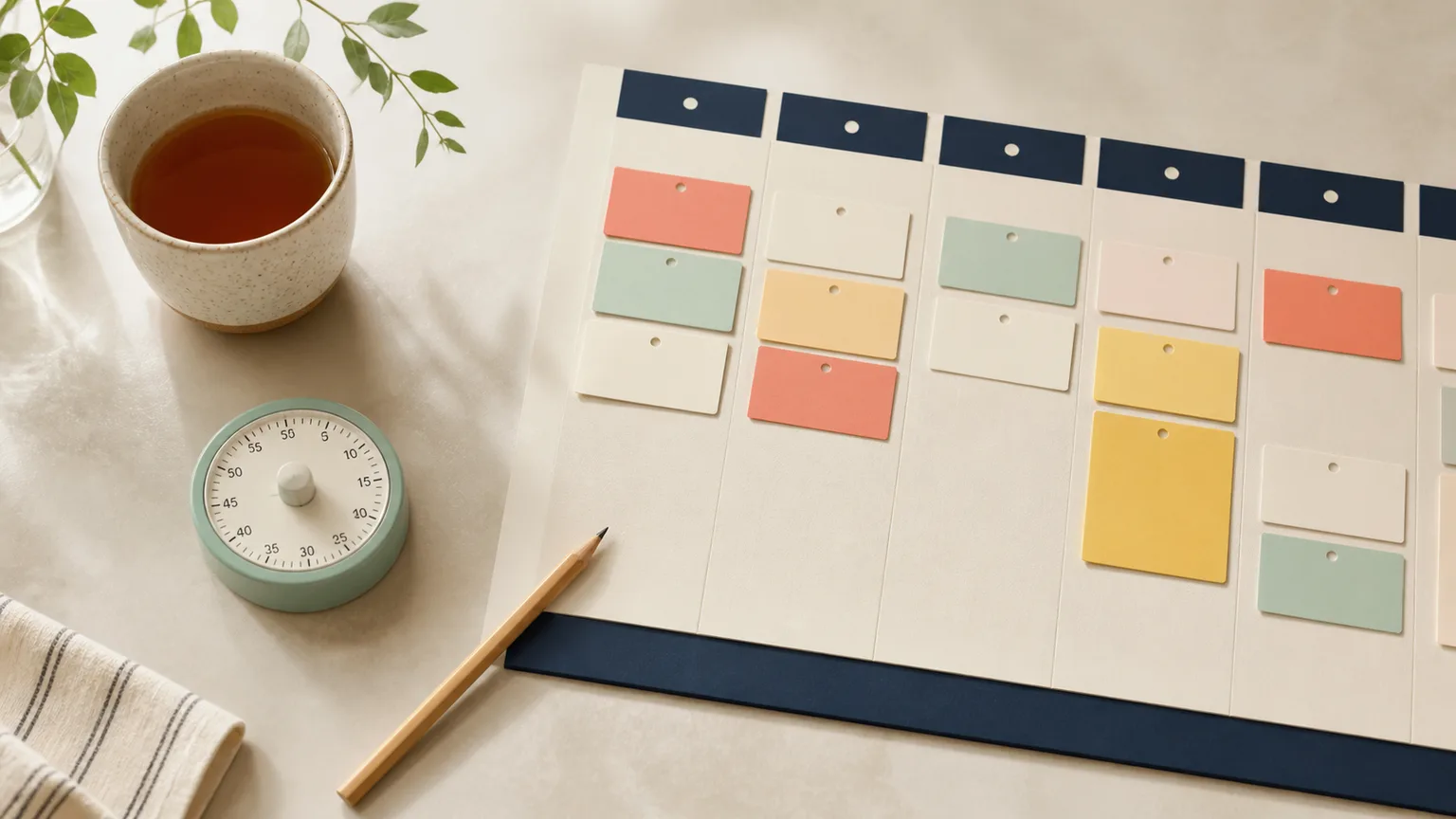
Flexible time blocking for ADHD uses broad work windows, visible finish lines, transition buffers, and planned reset points instead of scheduling every minute.
A block is a container for a kind of work, not a prediction that attention will behave perfectly. The method works best when moving a block is treated as normal planning information rather than failure.
Why rigid time blocks often collapse
Traditional schedules can hide setup, switching, waiting, communication, and recovery. When one task runs long, every later block shifts and the plan can feel broken. That all-or-nothing response is more damaging than the delay itself.
ADHD can involve difficulty with organization and time management, but no planner works universally. A useful experiment should make time more visible while preserving room for changing energy, interruptions, and real obligations.
- One delayed task causes you to abandon the whole schedule.
- You estimate only hands-on work and forget setup or transition time.
- Your calendar is full but still does not show a clear first action.
- You avoid looking at the plan after missing one block.
Build a flexible block plan in five steps
Use fewer, wider containers and decide in advance how the day can bend.
1. Place fixed commitments first
Add appointments, travel, caregiving, and real deadlines. These are constraints; do not fill the remaining white space as if transitions and recovery take no time.
2. Create two or three broad windows
Use labels such as focus, admin, and reset rather than minute-by-minute tasks. A window can hold several related actions without demanding a precise sequence.
3. Give each window one finish line
Define visible progress: send the draft, process five messages, or prepare tomorrow’s materials. A finish line keeps a category from expanding forever.
4. Add buffer and a reset point
Leave space after demanding blocks and choose a time to look again. At the reset, continue, move, shrink, or release the work intentionally.
5. Write a minimum version
Decide what counts on a lower-capacity day before it happens. The minimum might be opening the file, sending a dependency request, or preserving one essential appointment.
Flexible time blocks in different settings
| Situation | Unhelpful default | Kinder experiment |
|---|---|---|
| Office morning | 9:00–9:47 write entire report | 9:00–10:30 focus window; finish line is Findings draft; reset at 10:15 |
| Study day | Assign every chapter an exact hour | One reading window and one practice window with ten-minute transitions |
| Caregiving day | Pretend interruptions will not happen | Use two anchor windows tied to school drop-off and quiet time |
| Low-energy day | Rebuild the whole schedule | Keep fixed commitments and one ten-minute maintenance block |
Turn the method into a seven-day experiment
Do not rebuild your entire routine around one article. Choose one recurring situation where time blocking for adhd is relevant, and test the method for seven days or three real attempts. Keep the scope stable enough to learn from it.
- Record the starting condition. Note the time, available energy, environment, and the specific result you need.
- Begin with “Place fixed commitments first.” Use the smallest version that still touches the real situation.
- Practice “Give each window one finish line.” Change only one important condition rather than optimizing everything at once.
- Close with “Write a minimum version.” Leave evidence that makes the next attempt easier.
Measure friction, not personal worth
Use a tiny log with four fields: time to begin, number of unplanned switches, whether a visible result was produced, and how easy the task was to return to. A one-to-five “starting friction” rating can be useful when it describes the situation rather than your character.
At the end of the experiment, keep the part that reliably reduced friction, adapt the part that did not fit, and remove anything that created extra maintenance. One good outcome is a clearer explanation of what blocks the task—even when output does not immediately increase.
Adapt it to your environment
Planning experiments work best when the plan stays smaller than the work. Keep one trusted backlog, show only current commitments, and review at a predictable time. If maintaining the system takes more attention than it saves, remove a layer before adding a new tool.
What commonly goes wrong
- Planning at 100% capacity: white space is not wasted; it absorbs transitions and reality.
- Using categories without actions: write a visible finish line inside each window.
- Moving a block repeatedly without learning: note whether scope, timing, environment, or energy caused the mismatch.
A lower-capacity version
Keep appointments, choose one broad maintenance window, and write the smallest action that preserves tomorrow’s return path. Do not spend scarce energy rebuilding an elaborate timetable.
Evidence, limits, and when to seek support
These strategies are educational tools, not a diagnosis or treatment. The National Institute of Mental Health explains that ADHD involves persistent symptoms and functional impairment across settings. The CDC notes that there is no single diagnostic test and that other concerns can look similar. Seek qualified support when attention or task difficulties are persistent or significantly impairing daily life.
For a broader system, use our daily focus planner. If beginning is the main obstacle, try the task-paralysis reset. To protect attention after starting, read how to stop being distracted.
Time blocking for ADHD: common questions
How long should a time block be?
Use a length you can begin and review without dread. Ten to ninety minutes can work depending on task complexity and restart cost.
What if I miss a block?
Use the next reset point to continue, move, shrink, or release it. Missing one block should not erase the rest of the plan.
Should breaks be scheduled?
Yes, especially around demanding work and transitions. Buffers make the plan more honest and easier to resume.
Can time blocking diagnose or treat ADHD?
No. It is a planning experiment. ADHD assessment and treatment require qualified healthcare professionals.
Related reading
- If a rigid grid keeps collapsing, try ADHD-friendly planning without a rigid schedule.
- Set the first block the night before with planning tomorrow in five gentle minutes.
- If your blocks are always too short, that is the planning fallacy.
Your kind next step
Place tomorrow’s fixed commitments, create one broad focus window, and give it one finish line plus a ten-minute buffer. If you want help naming today’s strongest friction, take the private Focus Map quiz.