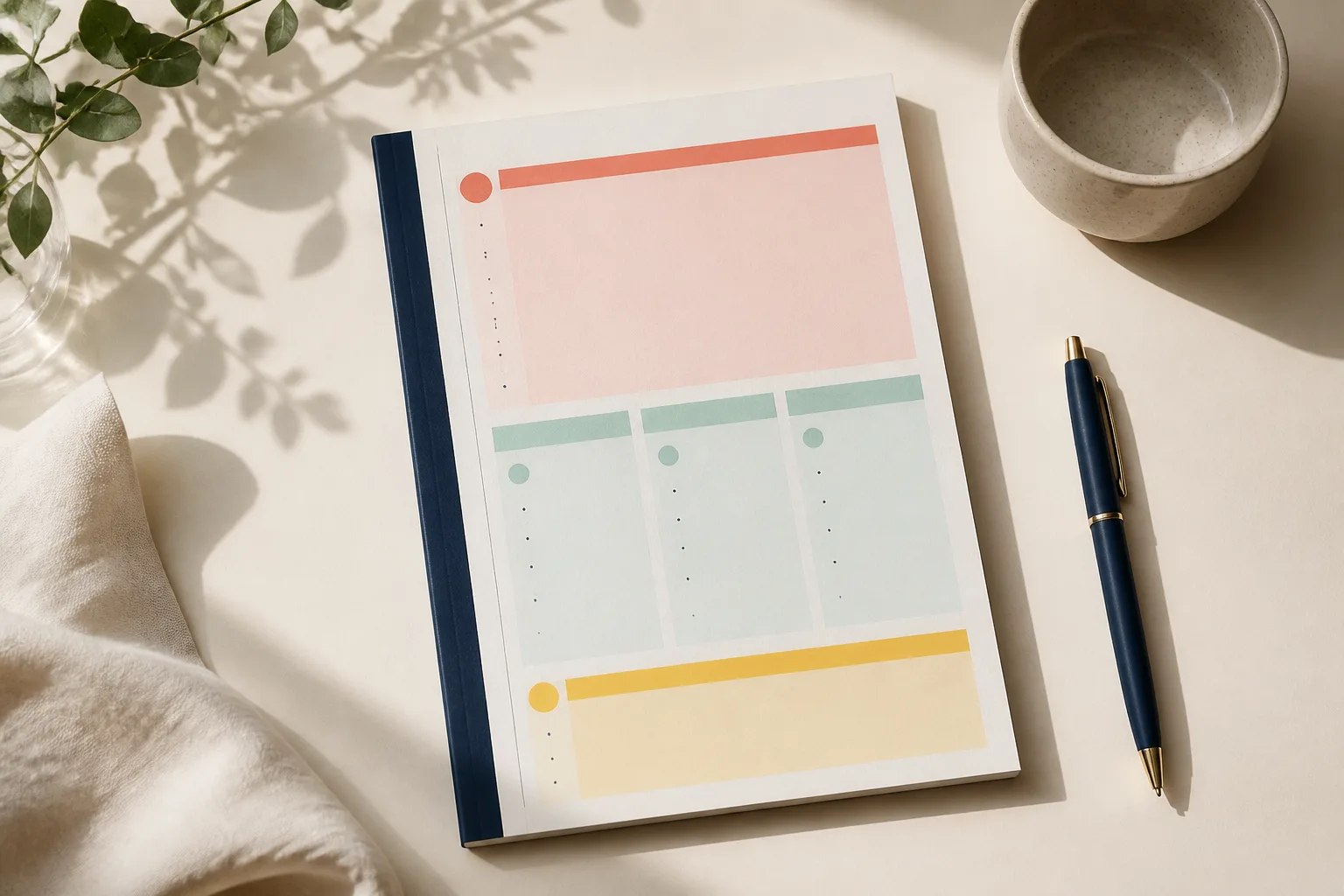
A useful daily focus planner should reduce decisions, protect what matters, and still make sense when energy changes. Use three levels: one meaningful priority, up to three maintenance tasks, and a minimum version you are genuinely allowed to count.
If maintaining the planner becomes a second job, the system is working against its purpose. The page should help you choose and return—not store every ambition you have ever had.
The three-level daily focus plan
Level 1: One meaningful priority
Ask: “If only one piece moves today, what would make the day feel useful?” Choose something specific enough to begin and important enough to deserve protection. “Work on marketing” is vague. “Draft three ad hooks for the quiz” creates a visible outcome.
One priority does not mean you will do only one thing. It means the day has one decision that other tasks should not quietly displace. If several items feel equally urgent, choose the one with the nearest real consequence or the one that unlocks other work.
Level 2: Up to three maintenance tasks
Maintenance tasks keep life and work from becoming noisier tomorrow: reply to one important email, book an appointment, pay a bill, wash the dishes, or update a customer record. Limit the list so it supports the priority instead of competing with it.
Bundle tiny chores when useful—“ten-minute admin round”—but keep the boundary clear. A maintenance section is not permission to copy an entire backlog onto today’s page.
Level 3: The minimum version
Decide what counts when capacity is low. The minimum version of “draft the report” might be “open the document and write the section headings.” The minimum version of “walk for thirty minutes” might be “step outside for five.”
The minimum is not a trick that secretly requires continuation. It is a legitimate finish line. If you often exceed it, that is useful; if you stop there, the plan still kept the thread alive.
- One priority with a visible finish line
- Up to three maintenance tasks
- A minimum version for low capacity
- The first physical action beside every item
- An “after today” parking list kept elsewhere
Add a first-action column
Beside each task, write the first observable action. This removes a decision at the moment resistance is most likely. “Tax documents” becomes “download January’s bank statement.” “Exercise” becomes “put shoes beside the door.” “Update website” becomes “open the homepage on a phone and record three problems.”
If the first action contains “and,” split it. “Open the brief and draft the outline” is two steps. The first-action column should tell you where your hands and eyes go next.
Plan around available energy
Estimate the demand of each task—high, medium, or low—without pretending you can predict the entire day. When your state changes, choose work that fits instead of abandoning the plan. This is not lowering standards; it is allocating capacity deliberately.
| Energy | Good task shape | Examples |
|---|---|---|
| High | Ambiguous, creative, or decision-heavy | Outline strategy, write a difficult section, compare options |
| Medium | Structured work with a known sequence | Edit a draft, build slides from an outline, prepare invoices |
| Low | Short maintenance with a visible finish | File documents, confirm an appointment, label assets |
Energy labels are temporary observations, not identities. A task that is high-energy today may become medium-energy after you clarify the first action or gather the missing information.
Keep an “after today” list
A separate parking list protects the daily page from every new idea. Add items without deciding when to do them, then review the list during a weekly or twice-weekly planning session. Today’s page should remain a decision, not an inventory.
If the parking list grows indefinitely, use three questions: Does this still matter? Is there a real next action? Does it belong to me now? Delete, delegate, schedule, or keep only what survives those questions.
A complete daily focus planner example
| One priority | Draft the first section of the client proposal |
|---|---|
| First action | Open the approved brief and paste the five required points |
| Three maintenance tasks | Send invoice; confirm Thursday call; order printer paper |
| Minimum version | Create the document and write five section headings |
| After today | Portfolio update; research microphone; redesign invoice template |
| Return note | Next: add one example beneath “Expected outcomes” |
This plan can survive interruption because it records both the outcome and the re-entry point. It can survive low energy because it has a real minimum. It can survive new ideas because they have a safe place that is not today’s commitment.
A five-minute planning routine
- Scan real constraints. Check appointments, deadlines, caregiving, travel, and available time.
- Choose one priority. Define what visible progress means today.
- Add maintenance. Select no more than three items that prevent tomorrow’s noise.
- Write first actions and a minimum. Remove ambiguity before the work begins.
- Choose a start cue. Decide when or after what event the first action will happen.
At the end of the day, avoid grading your worth. Mark what moved, move unfinished items back to the parking list, and leave a return note. A planner should improve the next decision, not produce a daily score.
How this helps with task paralysis and distraction
The first-action column reduces start friction. The single priority and return note make it easier to come back after distraction. The minimum version creates a plan for uneven capacity before the hard moment arrives.
When planning is not enough
Planning tools cannot diagnose or treat a health condition, and a better page cannot solve an unsafe workload or missing support. If organization or attention difficulties are persistent and significantly affect daily functioning, consider talking with a qualified professional. The National Institute of Mental Health provides an evidence-based overview of ADHD symptoms, assessment, and treatment.
Daily focus planner: common questions
What if I have more than one urgent priority?
Use the nearest real consequence or the task that unlocks the others. If two items truly must move, give each a small, explicit finish line rather than pretending both are all-day priorities.
Should I move unfinished tasks automatically?
No. Reconsider them. Keep, schedule, delegate, shrink, or remove each item. Automatic rollover can turn yesterday’s assumptions into today’s guilt.
Do I need a paper planner?
No. Paper, a notes app, or a simple document can all work. Choose the format you can see and update with the least friction.
How many tasks should be on a daily plan?
Start with one priority and up to three maintenance tasks. Add more only if the page remains a realistic decision rather than a complete backlog.
Related reading
- For a planning approach that bends instead of breaking, read ADHD-friendly planning without a rigid schedule.
- To set tomorrow up quickly tonight, use how to plan tomorrow in five gentle minutes.
- If your list keeps growing faster than your day, try a to-do list that does not create more overwhelm.
- When everything takes longer than you budgeted, this is why: the planning fallacy and time estimates.
- Turn any oversized item into a real first move with how to break a task into steps.
- Pair it with the free printable task breakdown worksheet for tasks that will not break down.
Your kind next step
On a blank page, write one priority, three maintenance tasks, and one minimum version. Add the first physical action beside each item. If choosing the priority still feels difficult, use the private Focus Map quiz to identify today’s main friction.