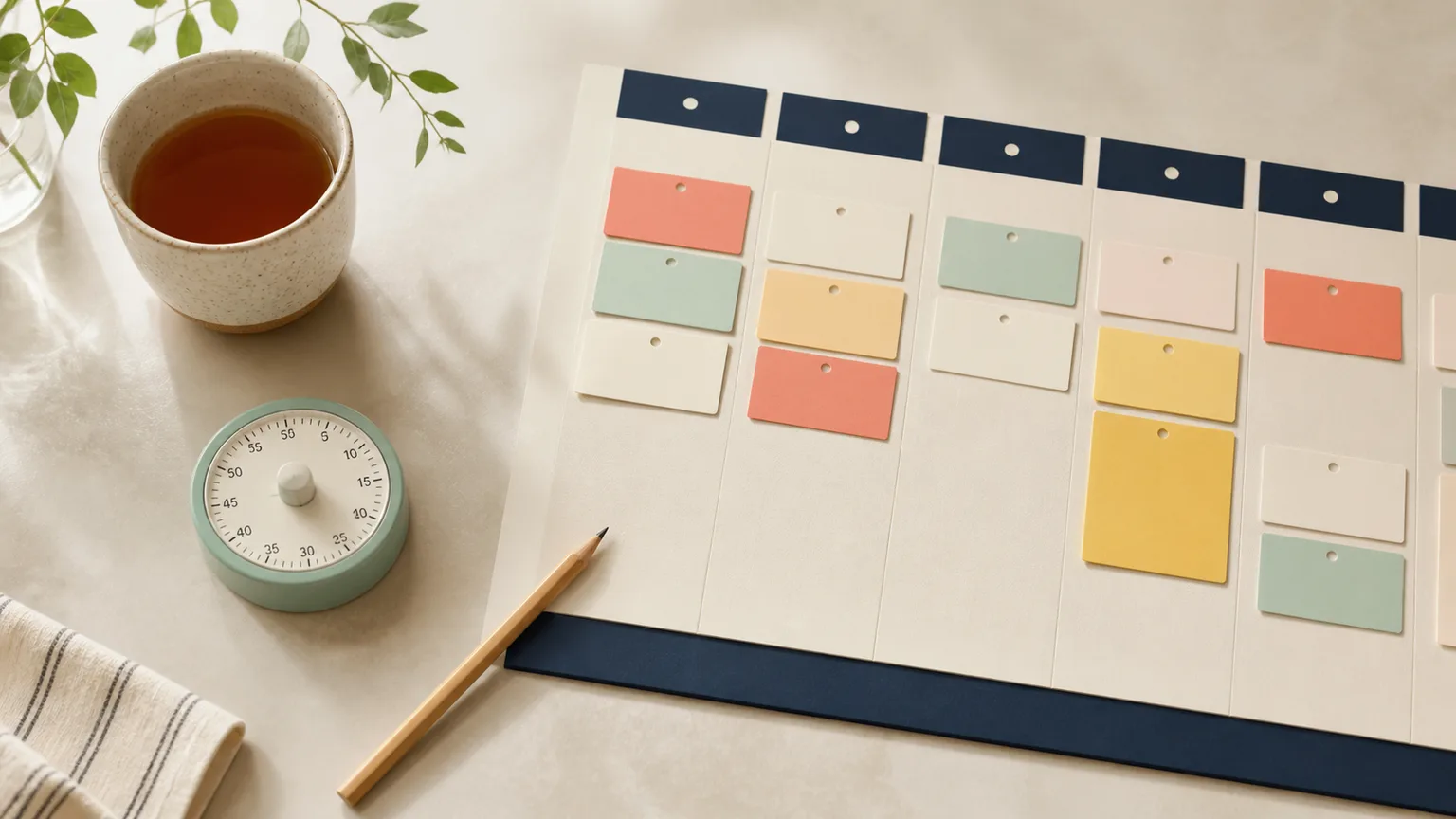
Decision fatigue is the practical drop in decision quality or willingness that can appear after many choices. Reduce it by removing low-value decisions, batching similar choices, and writing criteria before the difficult moment.
Feeling tired of choosing is not a personal failure and the phrase is not a diagnosis. The useful question is which decisions truly require fresh judgment and which can be handled with a default, a short rule, or a later review window.
What decision fatigue can look like in daily life
Choice load is often invisible. A simple task may require deciding when to begin, which tool to use, what quality is enough, whether another request is more urgent, and when to stop. Repeating that process across a day can make even small choices feel unusually expensive.
Stress, hunger, poor sleep, interruptions, and unclear responsibilities can amplify the effect. The solution is not to automate every part of life. It is to protect deliberate thinking for decisions that genuinely need it.
- You postpone small choices that would normally be easy.
- You reopen decisions that were already good enough.
- You default to scrolling, snacking, or browsing because choosing the next task feels costly.
- You make more impulsive choices late in a demanding day.
A daily plan that uses fewer decisions
Reduce the number of choices made in real time while keeping flexibility for situations that truly change.
1. Find repeating decisions
For two days, notice choices that recur: breakfast, work order, notification responses, meeting preparation, or exercise time. Do not optimize yet; simply identify repetition.
2. Create reversible defaults
Choose a normal option that is easy to override: the same first work block, a short lunch list, or one place for captured tasks. A default is a starting point, not a rigid rule.
3. Batch decisions into windows
Review email, errands, purchases, and scheduling at set times when possible. Batching prevents every incoming option from demanding immediate evaluation.
4. Write criteria before choosing
For meaningful decisions, list two or three criteria such as deadline, cost, reversibility, or impact. Criteria turn an emotional cloud into a comparison you can inspect.
5. Plan a low-choice ending
Before finishing work, choose tomorrow’s first action and prepare the needed material. The next day begins with movement rather than another priority debate.
Turn repeated choices into supportive defaults
| Situation | Unhelpful default | Kinder experiment |
|---|---|---|
| Morning work | Choose from the whole project list | Open the return note left yesterday and work for fifteen minutes |
| Meals | Decide from every possible option when hungry | Keep three easy default meals and choose freely when capacity is higher |
| Messages | Evaluate every notification immediately | Let urgent contacts through and review the rest twice daily |
| Purchases | Compare indefinitely | Set a budget, two required features, and a decision deadline |
Turn the method into a seven-day experiment
Do not rebuild your entire routine around one article. Choose one recurring situation where decision fatigue is relevant, and test the method for seven days or three real attempts. Keep the scope stable enough to learn from it.
- Record the starting condition. Note the time, available energy, environment, and the specific result you need.
- Begin with “Find repeating decisions.” Use the smallest version that still touches the real situation.
- Practice “Batch decisions into windows.” Change only one important condition rather than optimizing everything at once.
- Close with “Plan a low-choice ending.” Leave evidence that makes the next attempt easier.
Measure friction, not personal worth
Use a tiny log with four fields: time to begin, number of unplanned switches, whether a visible result was produced, and how easy the task was to return to. A one-to-five “starting friction” rating can be useful when it describes the situation rather than your character.
At the end of the experiment, keep the part that reliably reduced friction, adapt the part that did not fit, and remove anything that created extra maintenance. One good outcome is a clearer explanation of what blocks the task—even when output does not immediately increase.
Adapt it to your environment
Planning experiments work best when the plan stays smaller than the work. Keep one trusted backlog, show only current commitments, and review at a predictable time. If maintaining the system takes more attention than it saves, remove a layer before adding a new tool.
What commonly goes wrong
- Building too many rules: maintaining a complicated system creates more decisions. Start with one repeated choice.
- Treating defaults as obligations: a good default is easy to override when new information matters.
- Making major decisions depleted: pause irreversible choices when possible and return with written criteria.
A lower-capacity version
Use one “good enough” default for food, clothing, and the next maintenance task. Write down any important irreversible decision and choose a safer review time instead of forcing certainty while depleted.
Evidence, limits, and when to seek support
This guide offers educational planning ideas, not mental-health treatment. The World Health Organization’s stress guidance emphasizes practical coping skills, routine, sleep, connection, and appropriate professional support. If stress, exhaustion, avoidance, or concentration problems are persistent, worsening, or significantly disrupting daily life, consider speaking with a qualified healthcare professional.
For a broader system, use our daily focus planner. If beginning is the main obstacle, try the task-paralysis reset. To protect attention after starting, read how to stop being distracted.
Decision fatigue: common questions
Is decision fatigue a medical diagnosis?
No. It is a practical description used for the strain associated with repeated choices. Persistent or severe changes in thinking deserve professional assessment.
Are more options always worse?
No. Options can increase autonomy. Problems arise when many low-value choices repeatedly demand attention without useful criteria.
What is the fastest way to reduce decision fatigue?
Choose one recurring decision and create a reversible default. Preparing tomorrow’s first action is another high-leverage place to start.
Can a planner make decision fatigue worse?
Yes, if it requires constant categorizing and rewriting. Keep the today view short and let one trusted backlog hold everything else.
Related reading
- Fewer decisions start with a to-do list that does not create more overwhelm.
- Move tomorrow’s first choice to tonight using planning tomorrow in five gentle minutes.
- The wider skill set is covered in executive functioning skills for adults.
Your kind next step
Name one decision you make at least four times a week and write a reversible default you can test for seven days. If you want help naming today’s strongest friction, take the private Focus Map quiz.